


Key takeaways
The IRS requires documentation showing the date, amount, person who incurred the expense, and that it was a qualified medical expense; card statements alone are not enough.
An itemized provider bill or EOB paired with proof of payment is the strongest documentation for each HSA reimbursement.
Under the shoebox strategy, keep HSA receipts forever, because a withdrawal decades later must be substantiated with the original expense date and amount.
Store records outside any custodian's portal using a consistent naming convention like YYYY-MM-DD_provider_amount_type.pdf.
Missing documentation turns an HSA distribution into taxable income plus a 20% additional tax if you are under 65.
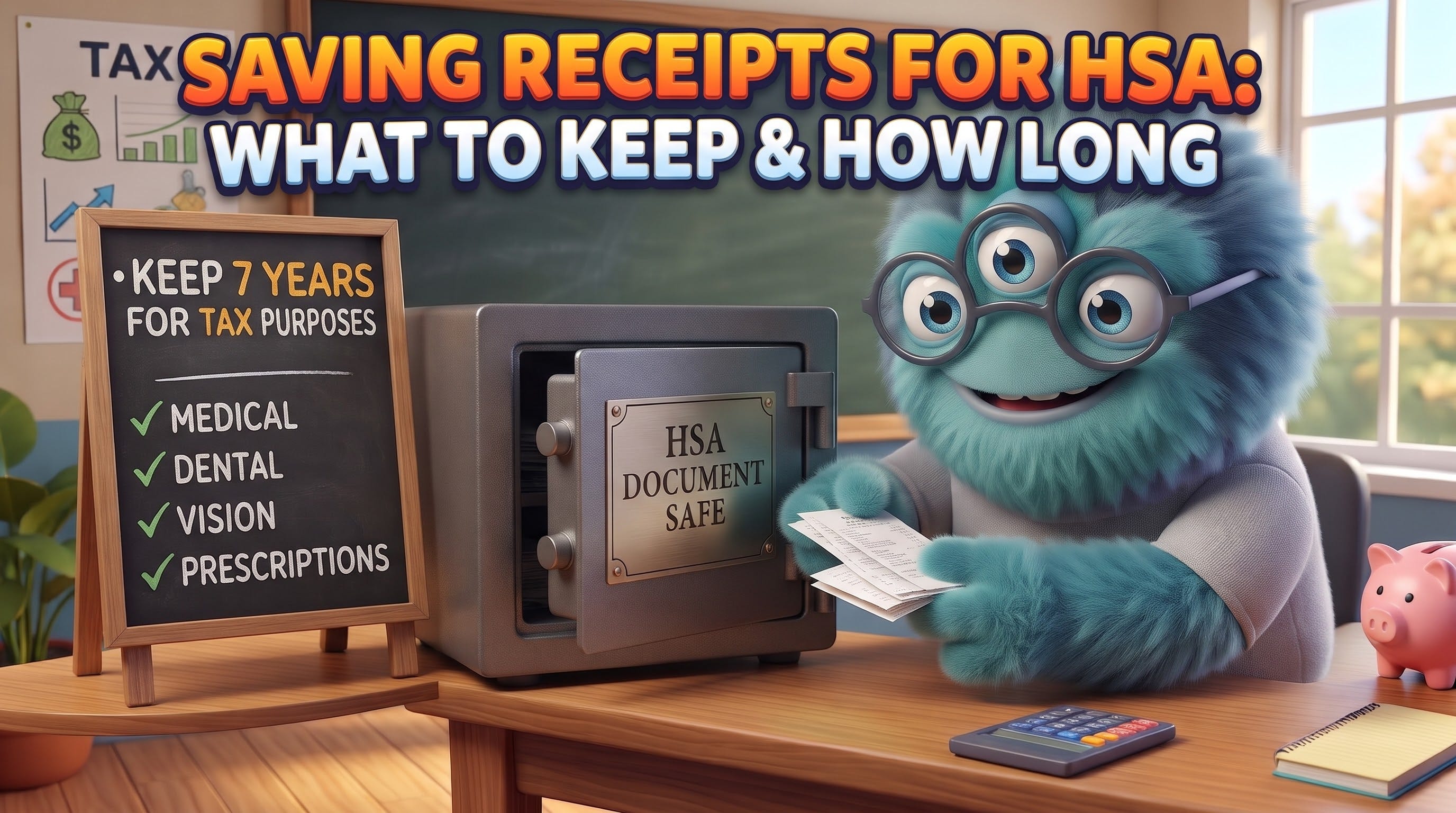
Saving receipts for HSA reimbursement means keeping the itemized provider bill or pharmacy receipt showing date, provider, and amount, plus the EOB as supporting proof, for as long as you defer reimbursement. IRS rules under IRC 213(d) require documentation that the expense was qualified; card statements alone are not enough. This guide maps each document type to what the IRS actually requires versus what is merely prudent.
What receipts are needed for HSA reimbursement?
The IRS requires documentation that shows four things for each distribution: the date, the amount, the name of the person who incurred the expense, and that it was a qualified medical expense. IRS Publication 969 states that you must keep records of qualified medical expenses paid with HSA distributions and that distributions not used for qualified expenses are taxable and subject to the 20% additional tax if you are under 65.
The three document types: EOB, itemized provider bill, card statement
DocumentWhat it provesWhat it leaves outEOBDate of service, provider, billed amount, your responsibilityNot a proof of paymentItemized provider billWhat was purchased, patient name, amount dueMay not prove you actually paidCard statementThat money left your account, date, merchantMerchant names are often cryptic; no line-item detail
What each one proves and what it leaves out
An EOB plus a matching card statement covers date, amount, and payment, but the merchant line rarely identifies the service. An itemized bill ties the amount to specific qualified medical expenses. The strongest file pairs an itemized bill with proof of payment, which is why a tool like SnapHSA stores the receipt image alongside the matched amount rather than just a total.
Do you need to save receipts if you pay out of pocket and reimburse later?
Yes. Paying out of pocket and deferring reimbursement does not reduce your documentation burden; it multiplies it. Every qualified medical expense you pay today becomes a future tax-free withdrawal, and the IRS can ask you to substantiate any distribution, years or decades after the purchase. The deferral window is precisely what makes the paper trail heavier, not lighter.
Why the shoebox strategy raises the stakes
When you reimburse in the same year, the receipt is fresh and easy to match to an EOB or card statement. Under delayed reimbursement, you are accumulating a decade or more of itemized receipts before you ever touch them. A spreadsheet plus a cloud drive works, but the failure mode is silent: one unscanned receipt in 2019 is invisible until the day you need it.
The one rule: expense date, not reimbursement date
What matters for substantiation is the date the expense was incurred, not the date you reimburse yourself. A withdrawal in 2040 can cover a qualified expense from 2025, as long as you can prove the expense date, amount, and that it was not previously reimbursed. That proof lives in your records, so build the system for the year you paid, not the year you get paid back.
Are EOBs enough or do you need itemized provider bills?
An EOB is good evidence, but it is not the receipt itself. What the IRS cares about is that the expense was for medical care as defined in IRS Section 213(d), and that you paid it. The question is which document proves both.
When an EOB is sufficient
An EOB showing the patient responsibility, provider, date, and service description is usually enough for a routine office visit or lab work, especially when paired with proof of payment. Many delayed-reimbursement households log the EOB and the cleared payment together and stop there.
When you must pull the itemized bill
If the EOB lists only a billing code or a generic line like "office visit," get the itemized bill. Same for anything an auditor could question: dental work that might be cosmetic, vision, therapy, or a service whose qualification is not obvious. The itemized bill names what was actually done.
Why card statements prove almost nothing on their own
A card statement shows "PHARMACY $84.12." It does not show the item was a qualified medical expense. Keep the pharmacy receipt or FSA-store printout underneath the statement line.
How long should you keep HSA receipts for taxes?
The three-year, six-year, and forever frameworks
The general rule people cite is three years from the date you filed your return, because that is the IRS's normal window to assess additional tax. Six years matters if you substantially understate income, and there is no limit in cases of fraud or a return never filed. But HSA receipts are not just tax documents. Every qualified medical expense you pay out of pocket creates a reimbursement right you can exercise decades from now, so the practical answer for a delayed-reimbursement strategy is: keep them forever.
What the IRS can actually ask for and when
If the IRS questions HSA distributions, it wants proof that withdrawals matched qualified medical expenses: itemized receipts, EOBs, or provider statements with dates and amounts. The audit window for the return covering a given distribution is the same three-to-six-year framework, but you cannot predict which year's withdrawals get examined, so pruning old receipts risks discording the exact expense you reimburse in year fifteen. Store everything; storage costs nothing compared to losing the triple tax advantage.
How should you store and organize HSA receipts digitally?
The spreadsheet-plus-cloud stack and where it strains
A spreadsheet for the log and Google Drive for the scans is the default stack, and it works. Its weak points are naming discipline and retrieval: ten years in, you need to find the itemized bill for a 2027 urgent-care visit and match it to a line in your log without re-reading every file.
Naming conventions that survive a custodian change
Name every file YYYY-MM-DD_provider_amount_type.pdf (e.g., 2027-03-14_urgentcare-x_185_itemizedbill.pdf) and store it outside any custodian's portal. Custodians change, merge, or purge archives, and IRS Publication 552 recommends keeping records as long as they may matter to tax reporting, which for delayed reimbursement means decades. Your records must live in storage you control, indexed independently of any provider.
Dedicated tools: Tripl, Reimbursable, HSAMatch, and SnapHSA compared honestly
Tripl, Reimbursable, and HSAMatch each target this workflow; evaluate them on retrieval speed, export format, and whether you can leave with your data intact. SnapHSA pairs a permanent log with per-snap token pricing instead of a recurring fee, which suits a deferral horizon measured in decades. Its honest gap: it stores records, it will not file claims with your custodian for you.
Which expenses qualify for HSA reimbursement and which don't?
The clear qualifiers
Most of what a household on an HDHP pays out of pocket is straightforwardly qualified: deductibles, copays, coinsurance, dental work, vision care, prescription drugs, and prescriptions glasses or contacts. Under IRC Section 213(d), if the expense is primarily for medical care of you, your spouse, or dependents, it qualifies. These are also the expenses that generate the itemized provider bills your shoebox strategy depends on.
The gotchas: premiums, Medicare, OTC without a prescription
Premiums are the big trap. You generally cannot reimburse premiums from an HSA while you're still working, though Medicare Part B and D premiums qualify once you're 65 (Medigap does not). Cosmetic procedures, teeth whitening, and gym memberships never qualify. OTC drugs and medicines require a prescription to be reimbursable, though items like bandages or crutches qualify without one. When an expense sits in the gray zone, keep the prescription or letter of medical necessity with the receipt before you reimburse yourself.
What happens in an IRS audit if your HSA receipts are missing?
If you can't document that a distribution covered qualified medical expenses, the IRS treats it as taxable income plus a 20% additional tax. You report distributions on Form 8889, and the Form 8889 instructions lay out the tax and penalty for non-qualified amounts. The shoebox strategy makes this worse in one specific way: a reimbursement you took in 2025 for a 2019 bill needs 2019 documentation, not a bank statement showing the withdrawal.
How the burden of proof works
The burden is on you, not the IRS. An HSA custodian's transaction history proves money left the account, not what it bought. A card statement showing a charge at a pharmacy names the merchant, not the items. Only an itemized bill or EOB tied to a dated, qualified expense closes the loop.
Partial documentation: what helps and what doesn't
An EOB plus a payment record for the same date and amount is usually enough to reconstruct a claim. A bare card statement, a provider's "balance paid" portal screenshot, or a receipt without itemized lines rarely survives scrutiny. If you're missing pieces, request a records reprint from the provider now; many only keep them a few years.
A self-audit checklist for your HSA receipt system
Run these checks against your records today:
Every out-of-pocket expense has a source document. An itemized provider bill or EOB for each claim, not just a card statement. A statement shows you paid; it doesn't show the service was a qualified medical expense.
Each entry in your spreadsheet links to the document. A row with no attached receipt is a future audit gap.
Your records are portable. If they live in one custodian's portal (HealthEquity users report clunky interfaces), export copies you control.
Your retention plan survives decades. Deferred reimbursement means records must outlast job changes, custodian switches, and hard drives.
You can reconstruct totals per year. If you can't sum qualified expenses by year in under an hour, reorganize now, before the receipts pile up.
FAQ
Can I reimburse myself for medical expenses from years ago with no receipts saved?
Not safely. If you cannot document that a distribution covered a qualified medical expense, the IRS treats it as taxable income plus a 20% additional tax if you're under 65. Request a records reprint from the provider now, since many only keep itemized bills a few years. An EOB paired with a matching payment record can sometimes reconstruct the claim.
Do I need to submit receipts to my HSA custodian or just keep them myself?
Just keep them yourself. Most custodians do not verify receipts at withdrawal time, but the substantiation burden stays on you if the IRS questions a distribution. Store itemized bills or EOBs with proof of payment in storage you control, indexed independently of any custodian, since portals can change, merge, or purge archives.
Is a credit card statement ever enough documentation for an HSA expense?
Almost never on its own. A statement shows money left your account and names the merchant, but it does not show what was purchased or that the expense was qualified. One exception in practice: an EOB plus a card statement matching the same date and amount can reconstruct a routine claim, though an itemized bill is still stronger.
What happens to my HSA receipts if I switch custodians or my old portal shuts down?
Nothing, if you stored copies outside the portal. Custodians change, merge, or purge archives, and your deferred-reimbursement records must outlast them. Export everything to storage you control, named consistently with date, provider, amount, and type, and indexed independently, so a custodian transition never leaves you unable to substantiate an old withdrawal.